RADAR: A new era of collaborative cosmic exploration
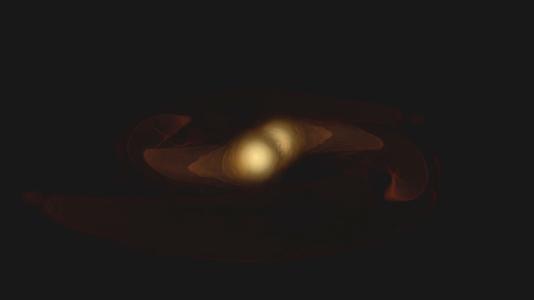
When two neutron stars collide, the universe puts on a spectacular show. These cosmic crashes send ripples through space-time called gravitational waves. They also unleash bursts of light across the electromagnetic spectrum, from powerful gamma rays to faint radio signals that can last for years.
A team of researchers from the U.S. Department of Energy’s (DOE) Argonne National Laboratory, Johns Hopkins University, the University of Chicago and the University of Illinois Urbana-Champaign have created a new framework to help scientists study these extraordinary events.
RADAR, or Radio Afterglow Detection and AI-driven Response, is a first-of-its-kind computational framework that combines data from gravitational waves and radio astronomy. This makes it possible for scientists to explore the universe using “multi-messenger astrophysics,” which means learning from different types of signals.
The discovery of gravitational waves and light from the neutron star merger GW170817 in 2017 showed just how much can be learned by combining different signals, called cosmic messengers. By bringing together gravitational waves with light across the electromagnetic spectrum, scientists learned details about the collision, its surroundings and how some heavy elements are made — insights no single signal could provide.
But this kind of follow-up is hard in practice. Gravitational wave alerts can cover large areas of the sky, data must be shared and analyzed quickly across many observatories and teams must compete for limited telescope time and computing resources. Coordinating these messengers in real time remains a major challenge for multi-messenger astrophysics, especially in the radio part of the spectrum.
Individual radio telescopes can only see small parts of the sky. And radio emission from multi-messenger sources is faint, taking months or years to appear. Future detectors are expected to find hundreds or thousands of gravitational wave sources each year. To keep up, astronomers need better ways to work together and make the most of limited telescope time.
RADAR helps solve these problems by using artificial intelligence to process gravitational wave and radio data at supercomputing centers. Since RADAR analyzes data where it is stored, it reduces the need to move large datasets. It also supports data-access limits (including proprietary data) and enables faster alerts. This approach speeds up discovery, reduces computing bottlenecks and improves coordination across teams.
When RADAR finds a gravitational wave event, it automatically starts searching for radio signals. It uses large language models to read public notices and messages from observatories around the world. Importantly, RADAR can also use private radio data, so scientists can work together without sharing raw data.
“This framework shows how we can do collaborative, cutting-edge astrophysics while respecting data rights and privacy,” said Eliu Huerta, a theoretical physicist at Argonne, the University of Chicago and the University of Illinois Urbana-Champaign. “RADAR is built to grow with the field, ensuring we can meet the challenges of the multi-messenger era.”
The team tested RADAR’s capabilities using GW170817, the only neutron star merger so far with a confirmed light signal. RADAR successfully combined gravitational wave data with both public and private radio observations. This helped improve estimates of the event’s shape and distance. This joint analysis shows how scientists can better plan follow-up studies and make discoveries faster.
“Multi-messenger astronomy thrives on coordination,” said Alessandra Corsi from Johns Hopkins. “RADAR gives us a way to plan and adapt follow-up strategies, even when the data itself can’t be shared directly. This capability will become increasingly critical as next-generation detectors transform today’s trickle of multi-messenger detections into a flood.”
Building RADAR took close collaboration among astrophysicists, AI researchers and computing engineers. The system was tested from start to finish at several top computing centers using real data from the neutron star merger GW170817. These tests showed that RADAR can reproduce the main results of the original multi-messenger analysis by combining gravitational-wave and radio data, even while operating across different computing systems.
Tests on platforms such as the Polaris supercomputer at the Argonne Leadership Computing Facility (ALCF), Delta and DeltaAI at the National Center for Supercomputing Applications, and the Advanced Research Computing at Johns Hopkins showed that RADAR can move less data, follow data-access limits and still coordinate large-scale analysis reliably. ALCF is a DOE Office of Science user facility.
“Developing the AI models for gravitational wave detection was exciting because we could see them working in real time across different supercomputers,” said Victoria Tiki from the University of Illinois Urbana-Champaign and Argonne. “That speed and adaptability are crucial for the next generation of gravitational wave events.”
“From an engineering perspective, building RADAR meant integrating AI, federated computing and high-performance infrastructure in a way that’s seamless for scientists,” added Parth Patel from Argonne. “It’s about turning cutting-edge technology into practical tools for discovery.”
One of RADAR’s most innovative features is its use of AI to read the messages astronomers use to share results from telescopes worldwide.
“One particularly exciting aspect of this project was integrating large language models into RADAR to automate the processing of notices and telegrams,” said Kara Merfeld from Johns Hopkins. “This work demonstrated both the potential of this approach and the opportunities for further optimization.”
Looking ahead, the RADAR team plans to expand the framework’s capabilities. They aim to develop AI models that can predict gravitational wave events before they happen, giving astronomers precious time to prepare for follow-up observations.
The team also wants to make radio data modeling faster so signals can be analyzed faster. As new gravitational wave and radio facilities start working, RADAR’s flexible design will help scientists to coordinate fast, efficient follow-up studies for a wider range of cosmic messengers, including neutrinos — tiny, neutrally-charged particles with almost no mass — and other signals from space.
The results of this research were published in The Astrophysical Journal Supplement Series.
Other contributors to this work include Zilinghan Li, Tekin Bicer, Ryan Chard and Hai Duc Nguyen from Argonne; Kyle Chard, Ian T. Foster, Maxime Gonthier and Valerie Hayot-Sasson from Argonne and the University of Chicago; and Haochen Pan from the University of Chicago.
This research was funded by the DOE, including support from the Office of Advanced Scientific Computing Research through the Diaspora project and Argonne’s Laboratory Directed Research and Development program. Additional support was provided by the National Science Foundation.
This article was originally published on the Argonne website.