Bridging Physics and CS: A Conversation with our latest IBM PhD Fellow, Soumik Ghosh
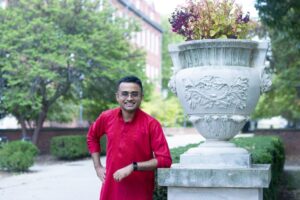
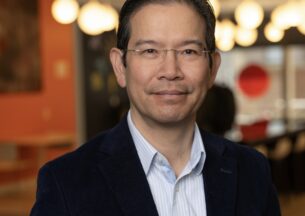
Sixth year PhD student Soumik Ghosh was recently awarded the prestigious International Business Machines (IBM) PhD Fellowship. This fellowship promotes research, innovation, and technology-based collaborations with universities by providing funding for PhD students in the final years of their PhD program. Ghosh, mentored by Associate Professor Bill Fefferman, received it for his innovative work understanding the power and limitations of quantum computing through complexity theory and direct study of physical problems, rather than theoretical models.
In this Q&A, Ghosh shares his background to discovering quantum computing, as well as his academic journey and what comes next for his research.
Tell me about your background and how you got to where you are today. How did you get into quantum computing?
Originally from Kolkata, India, I completed my undergraduate studies in electronics engineering at Jadavpur University. I then moved to Canada for my Master’s at the University of Waterloo. Currently, I am wrapping up my PhD in quantum computing under Bill Fefferman.
There’s a saying in India that “first you become an engineer, then you become something else.” That was certainly the case with me. I didn’t have a strong sense of direction when I started my undergraduate studies; it was more going with the flow and picking a specialization that seemed very popular with students at my university. However, I realized soon after joining that I am not at all passionate about electronic circuits, or about engineering, in general. You can’t change majors in India, so I had to stick with my choice for four years. But, on the side, I was slowly developing an interest in linear algebra, algorithms, and also a bit of quantum mechanics.
At that time, quantum computing was still a very nascent field with almost no one working on it in Kolkata. I still found a few small groups and reached out to them. They graciously took me in as a project mentee. I did a few small projects with them and also remember reading and being fascinated by John Watrous’s lecture notes on quantum computing, as well as Scott Aaronson’s inimitable blog posts on quantum computing and all the amazing discoveries of theoretical computer science over the last several years. I also did a brief summer internship in Los Angeles, where I worked with Itay Hen, who was then trying to program a big quantum computer, manufactured by D-Wave, that the University of Southern California had in its basement. That was my first time seeing a quantum computer—I remember being amazed by the sheer size of the thing!
When it was time to graduate, I grew bold and reached out to John, Scott, and many other leading quantum computing researchers for PhD positions. I got rejected by all of the PhD programs I had applied to. However, John was kind enough to offer me a position as a Master’s student under him. I got a stipend and the opportunity to work with John and his group. I was overjoyed. I took up his offer and spent two great years in Waterloo. I had no idea what subfields there were in quantum computing or what I was even interested in before I met John. But, during my Master’s, I started to have a sense. John’s a complexity theorist, so I mostly worked on developing mathematical tools to study some exotic quantum complexity classes. The class I studied had something to do with zero-sum quantum games, which, to me, seemed pretty cool.
Then came the time for applying to PhD programs again. I again mostly got rejected by a lot of places. Bill was just starting his group at UChicago, and he was one of the only ones who took me in. I remember the day of my grad visit—it was just before the lockdowns started in 2020. I was on one of the very last flights from Toronto to Chicago. At that point in my life, I was very torn between whether to continue at Waterloo or join a new PhD program in a different country. I remember coming to campus and knocking on Bill’s office on the day of the grad visit, and then, what I remember is that I was very impressed by his energy and enthusiasm. His pitch to me was all about joining forces to develop a new type of theory that would combine the best of physics with the best of computer science. I was pretty sold. It seemed to be something genuinely new and exciting. I was never too good at physics in high school, but I was always very impressed by physicists. This would be my excuse to learn some actual physics and not just be stuck in the weeds of math. That seemed very cool! So, I joined UChicago.
What does the IBM PhD Fellowship mean to you?
It is a privilege to be recognized by IBM, an organization I have worked with extensively throughout my PhD alongside some of my most valued collaborators. I have to mention Kunal Sharma and Abhinav Deshpande by name, as I have had, and continue to have, many wonderful research conversations with both of them. I fondly remember Kunal hosting me at IBM Research in Yorktown Heights countless times. IBM and UChicago are two of the strongest names in quantum computing in the Midwest, and they have a lot of common overlap in terms of research vision. I hope these bonds get even stronger with time.
What was your research proposal on, and what are you working on now?
The main goal of my research is to understand the power and limitations of quantum computers. However, my work is very different from traditional quantum complexity theorists— instead of working with idealized models of computation that model mathematically rich problems but are often divorced from physical considerations, I use complexity theory and theoretical computer science, more broadly, to directly study problems in physics. My goal is to go beyond the traditional focus area of theoretical computer science and lay the foundation stones of a new field — which I term “physical complexity theory” — that aims to build a bridge between computer science and physics.
I aim to build this bridge in both experimental and theoretical physics. To be more concrete, I am currently working on using complexity theory to study quantum phenomena like entanglement, to design scalable demonstrations of quantum supremacy that can also be classically verified. I am also thinking about useful tasks that can be solved by the quantum computers of the present.
Why is this research important?
I view this as a change of mindset. Physics has greatly influenced computer science over the years by giving us a framework and a language to think about quantum computers. I aim to flip the narrative and ask how computer science can influence physics. The 20th century was the era of big discoveries in physics. I think the 21st century is shaping up to be the century of brilliant advances in computer science. I believe many of these conceptual advancements are powerful enough to strongly influence other fields like physics.
What are your longer-term goals?
I want to discover that one “killer app” of quantum computing. We are making steps towards that. Modern devices have extremely advanced noise controls, and the qubit counts are slowly going up, so it’s starting to go into the realm of when people can just experiment with these devices themselves and figure out a killer app.
This is how it happened for classical computing—all the advances in classical computing, from video-gaming to the internet, happened after people had computers to play with. They played with these computers and discovered these wonderful things through trial and error and a bit of luck.
We are not quite there yet for quantum computers, and it is possible that quantum computers can not be miniaturized beyond a certain point and will be specialized computers that sit inside a cryo-chamber in the basement of a lab or something like that. Then, the onus shifts to us theorists to use intuition to minimize the trial and error, and also the component of luck. It’s intuition that has to come from physics, computer science, as well as the experiments themselves. It’s really a fascinating open challenge!
Anything else to add?
I wanted to say that Bill is an amazing mentor, and it wouldn’t have been possible without him. I had a lot of fun in my PhD, and I am glad to have been a part of his group.